Content Warning
This exhibition contains discussions of mental health, institutionalisation, and homophobia.
Terminology
In this exhibition we use the term D/deaf. This is a term that includes people who identify as ‘deaf’ (those who experience hearing loss and use written and spoken language), and those who identify as ‘Deaf’ (those who identify as being culturally Deaf).
We also refer to the ‘Social Model of Disability’ which argues that it is society who ‘dis-ables’ people who have impairments by isolating and excluding them from participation in wider society.
D/deaf Accessibility to Healthcare Through the Ages
Because of their impairment, society in the past and the present dis-ables D/deaf people and discriminates against them. This makes accessing healthcare a struggle for D/deaf people.
This exhibition maps focal points along the history of this challenge. It highlights different types of barriers that D/deaf people have faced, but also foregrounds the methods employed by D/deaf people to overcome these.
This is an issue that D/deaf people still face today, in healthcare and in other fields such as education. For example, we were unable to access an interpreter to conduct collaborative research for this exhibition.
D/deaf Accessibility To Healthcare Through The Ages hopes to educate and raise awareness for these challenges and methods of activism.
Timeline
How Was D/deafness and Access to Healthcare Portrayed Historically Pre-1900s?
Pre-1900 society actively discriminated against and dis-abled D/deaf people because of their impairments.
This section of the exhibition presents the ways that D/deaf people in the Victorian Era and before were catered to, or discriminated against, or tried to overcome barriers to healthcare.
By including an image of a historical asylum, this part of the exhibition aims to draw attention to the ways in which D/deaf people were separated from society as a whole and how that reflected Victorian society’s attitudes towards disability.
Images of historical sign language and hearing aids are also included. How do they look different from modern day models?

Deaf and Dumb people perform a play in sign language. Wood engraving, 1884
(Dumb is an outdated historical word for people who do not talk. Nowadays the terms “non-speaking” or “nonverbal” are preferred)
Although D/deaf and non-speaking people were expected at the time to learn how to read and write instead of using sign language, many in the community still used it despite the stigma.
Both men and women used it, as seen in the poster. The poster also includes some examples of hand signs at the top.
Notice: This image has been removed
It depicted a 19th century asylum where D/deaf and other disabled people were often sent.
This engraving portrayed an asylum, a place where D/deaf and non-speaking people were sent in the past by prejudiced family members to keep them away from society.
This segregation of people who were considered disabled from those who weren’t was due to harmful historical negative attitudes towards disability, such as the 19th century idea of eugenics.
We want to focus on empowerment and self-advocacy within the D/deaf community, so we have opted not to show it, as we do not wish to replicate the discrimination they have faced historically.
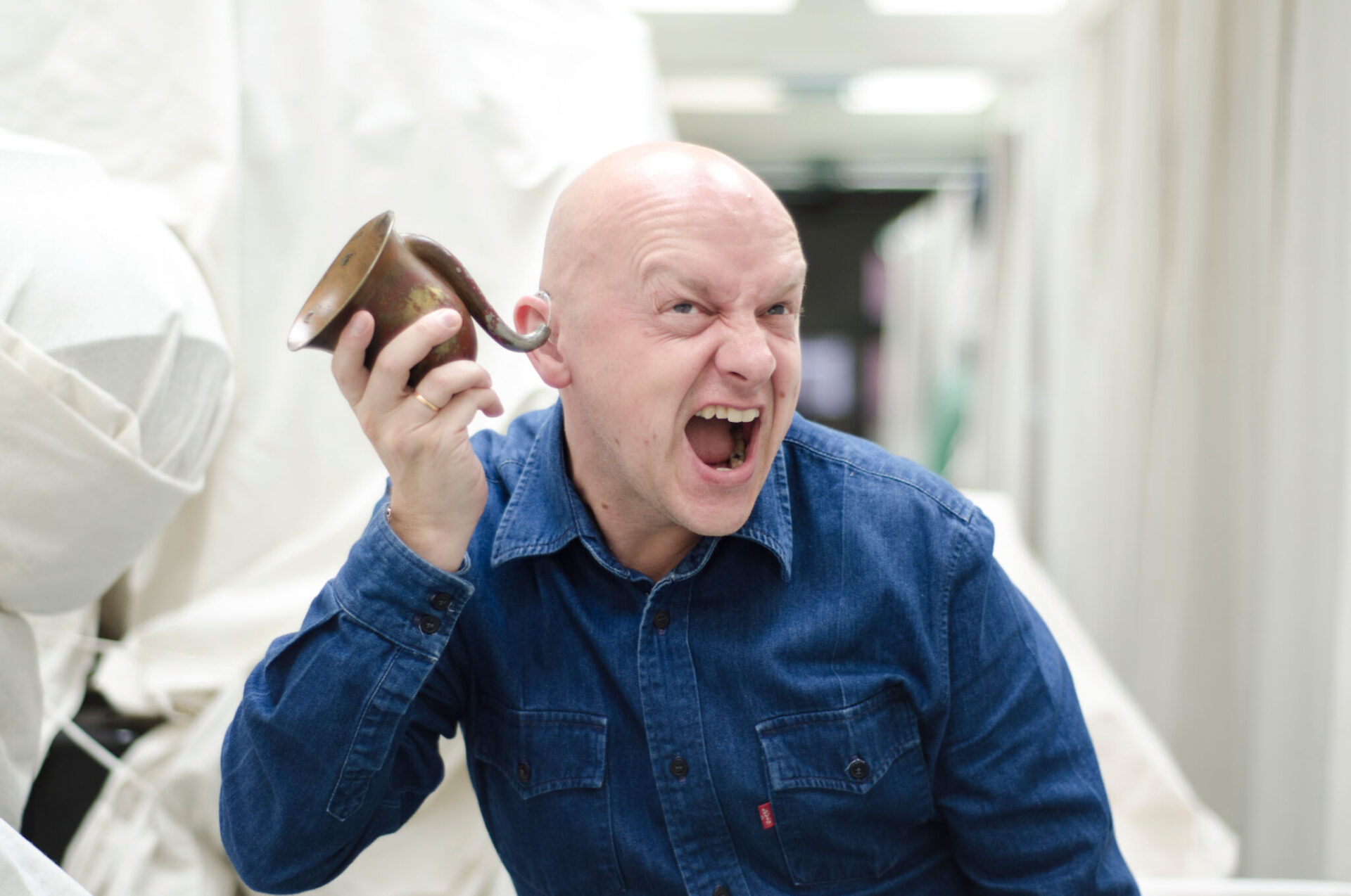
Mark Smith with contemporary and Historical Hearing Aids (Richard Sandell)
These photographs show a man wearing modern hearing aids, whilst using historical ones.
Before the invention of electronic hearing aids, devices like ear-trumpets were used by the D/deaf and hearing impaired to amplify what sounds they could hear. It was an early form of accessibility.
How Did D/deaf People Overcome Their Exclusion From Global HIV/AIDS Health Campaigns?
In 1981 the HIV/AIDS epidemic began, affecting men who have sex with men disproportionately. Healthcare accessibility and support was difficult for those affected because of misinformation and prejudice.
D/deaf people struggled significantly more because global health campaigns shared information through mediums such as TV and radio, which were not accessible. Many sexual health clinics did not provide interpreters or additional access.
D/deaf individuals and groups created organisations and methods of information distribution that were specifically created by and targeted to the D/deaf community.
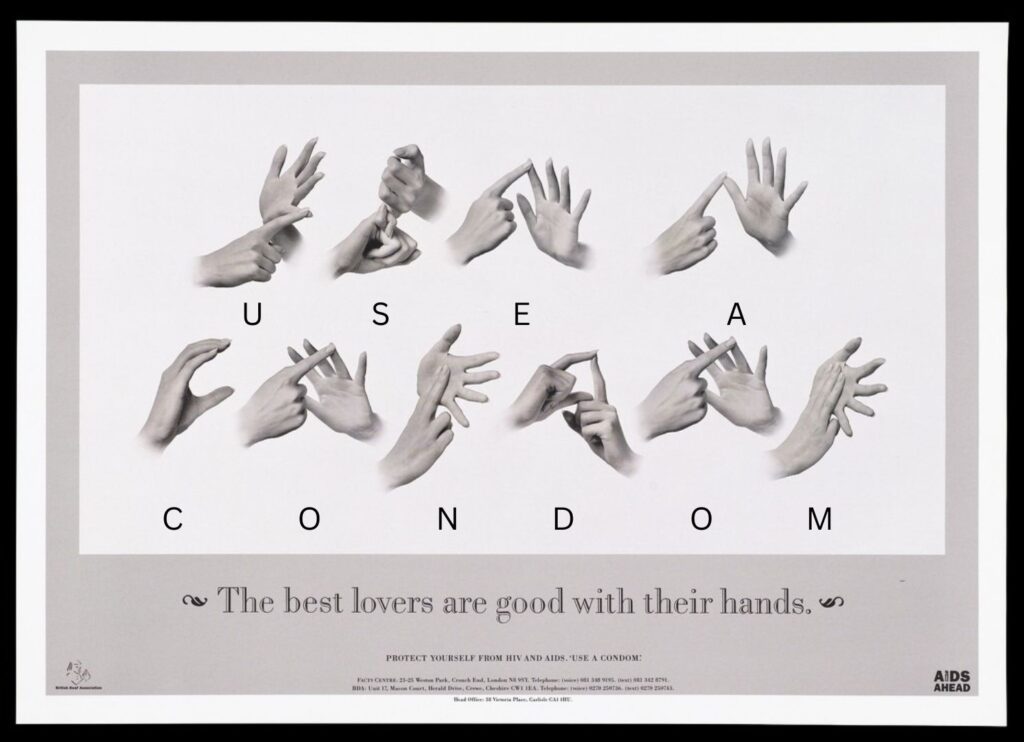
One method was the production of advertisements that were targeted at and accessible to D/deaf individuals. This was often achieved by using images of fingerspelling to spell out messages.
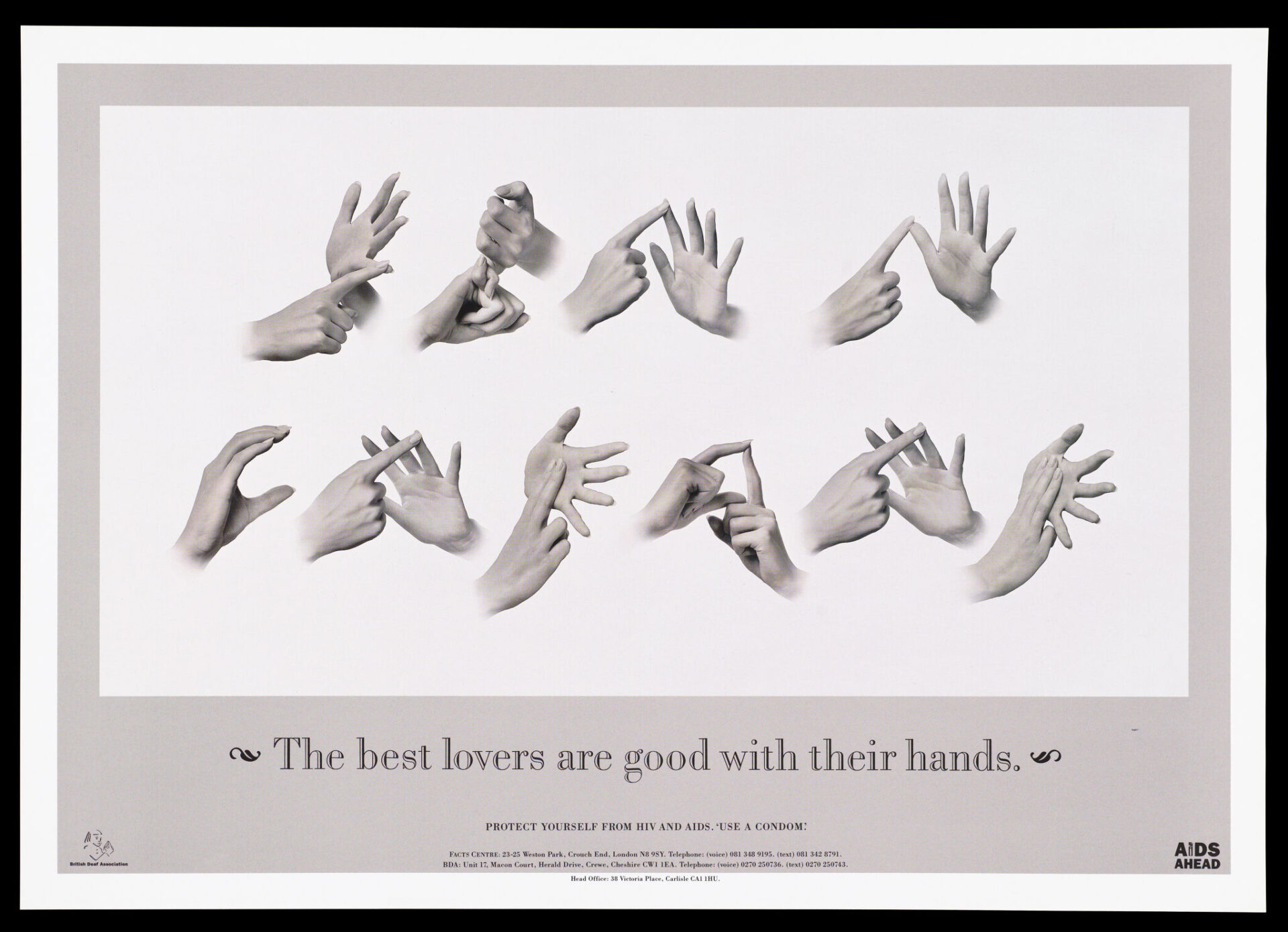
‘The best lovers are good with their hands’ advertisement for safe sex by the British Deaf Association, Lithograph, 1990s
To overcome inaccessible campaigns, the British Deaf Association used British Sign Language (BSL) fingerspelling in this advertisement to directly target D/deaf people with safe sex messages.
If you do not know the BSL alphabet, can you work out the message using the chart provided below?
The written message uses humour and irony; this was common for many HIV/AIDS posters.
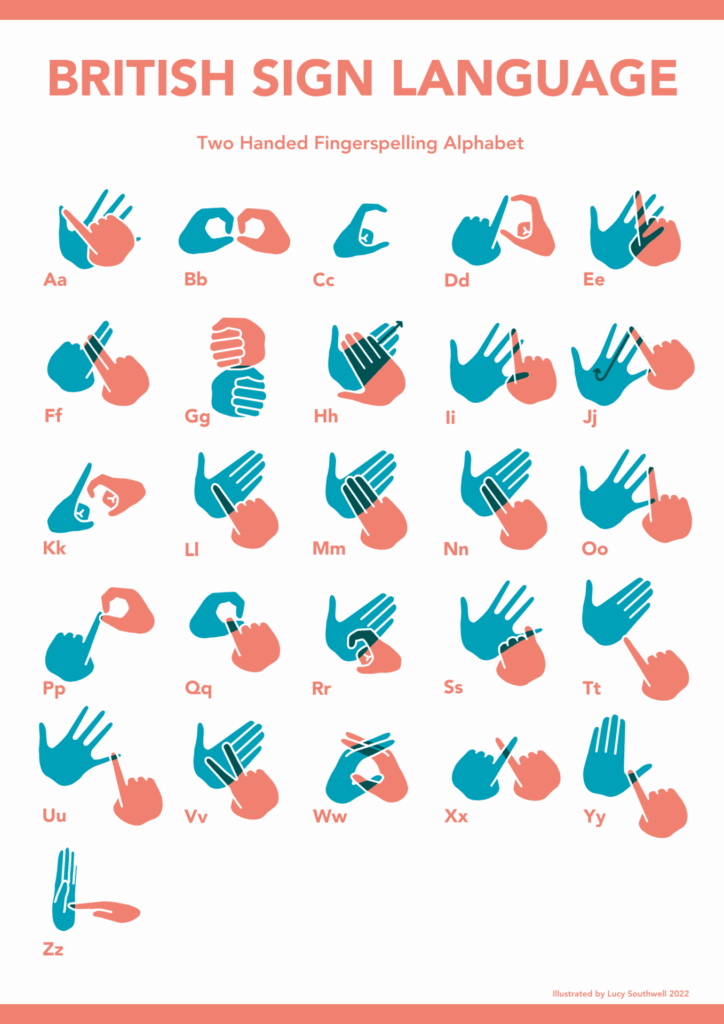
Notice: The next image is not displayed here
It contained sensitive and sexually explicit content.
Due to a lack of details on the subjects, we have chosen not to display it.
Alt text: A poster, at the top are images of German Sign Language fingerspelling signing the message ‘Safer Sex’. Below are three images of two men engaged in sexually explicit behaviour. On each image is a message in German, these read in english, ‘Fucking with a condom’, ‘Kissing is safe’, ‘Blowjob without ejaculation’.
‘Safer Sex’ advertisement by the Deutsche AIDS-Hilfe, Colour Lithograph, 1985. German text reads from left to right: ‘Fucking with a condom’, ‘Kissing is safe’, ‘Blowjob without ejaculation’
To overcome inaccessible campaigns, the Deutsche AIDS-Hilfe used the German Sign Language ‘fingeralphabet’, in this advertisement to directly target D/deaf people with safe sex messages.
The use of a phrase that means the same thing in the English and German languages, ‘Safer sex’, may point to the global nature of the HIV/AIDS campaign.
What are recent local community developments globally?
The Wellcome Collection contains works mainly relating to D/deaf people in the UK, but similar museums exist in other countries. This section introduces D/deaf collections in various countries that have opened recently. These museums contribute to preserving and promoting the D/deaf and sign language culture and history, and are central to the modern D/deaf community in their local regions. Museums’ engagement with D/deaf people is expanding globally and locally.

What’s Next?
Society still dis-ables D/deaf people today. D/deaf charities today argue that the NHS does not have the right systems to meet the access needs of D/deaf people. This means that D/deaf people avoid finding help, do not understand the help that is given to them, and do not feel in control of their health.
There are many other barriers within society. When we made this exhibition, we came up against barriers to access within the education system when we were unable to access an interpreter to help us with collaborative research.
The collection that we worked with also had limitations that impacted our representation of D/deaf people, leading to representations of mostly white male stories. We attempted to overcome this by highlighting women’s stories and LGBGQ+ stories.
There are many D/deaf people who experience multiple forms of marginalisation and it is important to highlight this and avoid presenting a single story.
We have linked resources below that highlight stories that go beyond our exhibition.
Deafax, What Are Big D and Little D?, <https://www.deafax.org/news/what-are-big-d-and-little-d/> [accessed 4 December 2025]
Deaf Rainbow UK, Supporting the Deaf LGBTQIA+ Community, <https://deafrainbowuk.org.uk/> [accessed 4 December 2025]
Disability Rights UK, Language and the social model of Disability: <https://www.disabilityrightsuk.org/social-model-disability-language?srsltid=AfmBOoqKqRG9m3MwR98VOBMtK8gJoqfaYYChq01-vRczZ96R4nvd1iQR> [accessed 04/12/2025]
Gala, Margins For Error, <https://gala.co.za/> [accessed 4 December 2025]
Gallaudet, The Deaf Experience on Display, <https://gallaudet.edu/museum/> [accessed 4 December 2025]
Historic England, Disability in the 19th Century, https://historicengland.org.uk/research/inclusive-heritage/disability-history/1832-1914/ [accessed 04/12/2025]
Norsk Døvemuseum, Norsk Døvemuseum, <https://norsk-dovemuseum.no/> [accessed 4 December 2025]
RNID, and The Deaf Health Charity Signhealth, Still Ignored: The Fight For Accessible Healthcare, 2025 Policy Report England (2025), <https://signhealth.org.uk/wp-content/uploads/2025/04/ENGLAND-Still-Ignored-The-fight-for-Accessible-Healthcare-policy-report-FINAL.pdf> [accessed 4 December 2025]
Scope, Social Model of Disability: https://www.scope.org.uk/social-model-of-disability [accessed 04/12/2025]
Sign Language and Deaf Museum, Exploring the rich world of Japanese deaf culture, <https://signanddeafmuseumjapan.com/> [accessed 4 December 2025]
Norsk Døvemuseum, Exhibition, < https://norsk-dovemuseum.no/en/exhibitions > [accessed 4 December 2025]
The Finnish Museum of the Deaf, What’s On, <http://www.kuurojenmuseo.fi/?p=370&lang=en> [accessed 4 December 2025]
CCTV.com, Comprehensive display of sign language culture. The first sign language museum in China opened in Nanjing,
< https://news.cctv.com/2024/09/21/ARTIkulb6gFpooqj5yB38kkO240921.shtml > [accessed 4 December 2025]
Gay and Lesbian Archives(GALA), The Deaf Office, < https://gala.co.za/archive/archiving-gala/the-deaf-office/ > [accessed 4 December 2025]
BFI Player, AIDS – Monolith, <https://player.bfi.org.uk/free/film/watch-aids-monolith-1987-online> [accessed 4 December 2025]
Carpenter. M, 2009, Health, Medicine and Society in Victorian England, Praeger, California, pp.139
Cleall. E, “Silencing Deafness: Displacing Disability in the 19th Century”, Portal: Journal of Multidisciplinary International Studies, 12.1 (2015), pp.115-130,
Deaf Rainbow UK, Achievements of Deaf Rainbow UK, <https://deafrainbowuk.org.uk/achievements/> [accessed 4 December 2025]
Deaf Rainbow UK, Deaf LGBTQIA+ History UK, <https://deafrainbowuk.org.uk/deaf-lgbt-history-uk/> [accessed 4 December 2025]
Deutsche Aidshilfe, 40 years of German AIDS Service Organisation. More than you think. <https://www.aidshilfe.de/de/40-jahre-dah#Wie_alles_begann:_Die_Aids-Krise> [accessed 4 December 2025]
Historic England, Disability in the 19th Century, https://historicengland.org.uk/research/inclusive-heritage/disability-history/1832-1914/ [accessed
04/12/2025]
National Aids Trust, UK HIV Statistics (2024), <https://nat.org.uk/about-hiv/hiv-statistics/> [accessed 4 December 2025]
National Aids Trust, World Aids Day, <https://worldaidsday.org/> [accessed 4 December 2025]
NHS, HIV and AIDS, <https://www.nhs.uk/conditions/hiv-and-aids/> [accessed 4 December 2025]
Rhodes, Erin, ‘Bournemouth’s John Eaddie: Britain’s First AIDS Victim’, Daily Echo, 14 December 2024, <https://mh-v5.bournemouthecho.co.uk/news/24791413.bournemouths-john-eaddie-britains-first-aids-victim/> [accessed 4 December 2025]
The National Archives, Section 28: impact, fightback and repeal, <https://www.nationalarchives.gov.uk/explore-the-collection/stories/section-28-impact-fightback-repeal/> [accessed 4 December 2025]
The V&A, The best lovers are good with their hands, <https://collections.vam.ac.uk/item/O203869/the-best-lovers-are-good-poster-mcauslan-harry/#:~:text=A%20poster%20with%20an%20image%20of%20%22Use,part%20of%20the%20British%20Deaf%20Association.%20Dimensions.> [accessed 4 December 2025]
United Nations, International Day of Persons with Disabilities, 3 December, <https://www.un.org/en/observances/day-of-persons-with-disabilities> [accessed 4 December 2025]
West Yorkshire Queer Stories, AIDS and the Deaf Community (2019), <https://wyqs.co.uk/stories/aids-and-the-deaf-community/> [accessed 4 December 2025]
World Health Organisation, HIV, <https://www.who.int/data/gho/data/themes/hiv-aids/hiv-aids> [accessed 4 December 2025]
World Health Organisation, HIV Data and Statistics, <https://www.who.int/teams/global-hiv-hepatitis-and-stis-programmes/hiv/strategic-information/hiv-data-and-statistics> [accessed 4 December 2025]
Copyright
Wellcome Collection:
Wellcome Collection, ‘Asylum for the deaf and dumb, Camberwell. Engraving by I.C. Varrall after himself, 1822’, [online] <https://wellcomecollection.org/works/m4rjcdpj/images?id=qmd6nmzn> [accessed 1 December 2025]
Wellcome Collection, ‘Deaf and dumb people from the Hackney Mission to Deaf and Dumb performing plays, sign language, and portraits of staff at the institution. Wood engraving by J. Swain, 1884, after H. Morehen’, [online] <https://wellcomecollection.org/works/c5ctn7w4/images?id=num79q6n> [accessed 1 December 2025]
Wellcome Collection, ‘Hands spelling out in sign language ‘Use a Condom’; advertisement for safe sex by the British Deaf Association. Lithograph’, [online] <https://wellcomecollection.org/works/pbam9a76/items> [accessed 1 December 2025]
Wellcome Collection, ‘The Deaf Community in Berlin by the Deutsche AIDS-Hilfe’, [online] <https://wellcomecollection.org/works/bw756f9e/items> [accessed 1 December 2025]
Wellcome Collection, ‘Mark Smith with historical and contemporary hearing aids’, [online] <https://wellcomecollection.org/works/ya28m4js/images?id=hr4g4fxh> [accessed 1 December 2025]
Wikimedia Commons:
Southwell, Lucy, ‘English: Two Handed British Sign Language Fingerspelling Poster’, [online] <https://commons.wikimedia.org/wiki/File:British_Sign_Language_Fingerspelling_Poster_(Block_Shapes).png> [accessed 1 December 2025]
.png)
This exhibition was created using open access material from the Wellcome Collection.
Thank you for visiting the exhibition and helping us raise awareness of this history and current challenge.
Yilan Shen, Lucy Cameron, Elizabeth Cairns, Ayano Sato