The Sky‘s The Limit? Amelia Earhart Proved It Was Just The Beginning
Amelia Earhart, one of America's most celebrated aviators, gained fame for being the first woman to fly solo across the Atlantic Ocean in 1932. Earhart's interest in aviation began during the First World War when she worked as a nurse's assistant. She was a strong advocate for women’s rights, encouraging women to break free from societal constraints and pursue careers in aviation.

Tragically, in 1937, during an attempt to circumnavigate the globe, she disappeared over the Pacific Ocean and was declared lost at sea leaving behind a mystery that still has us scratching our heads.

Her legacy lives on through the Ninety-Nines, the organization for female pilots she helped establish, and she remains as an enduring symbol of female empowerment and a cultural icon.
Amelia Earhart’s Portrait
This photograph from 1932 introduces us to Amelia Earhart. It was taken in the year that she shot to fame and was awarded the Distinguished Flying Cross for her heroism and extraordinary achievement. We can see her posing in a chair, wearing a flight jacket and trousers with her iconic short hair cut. She looks away from the camera with a very determined look on her face.

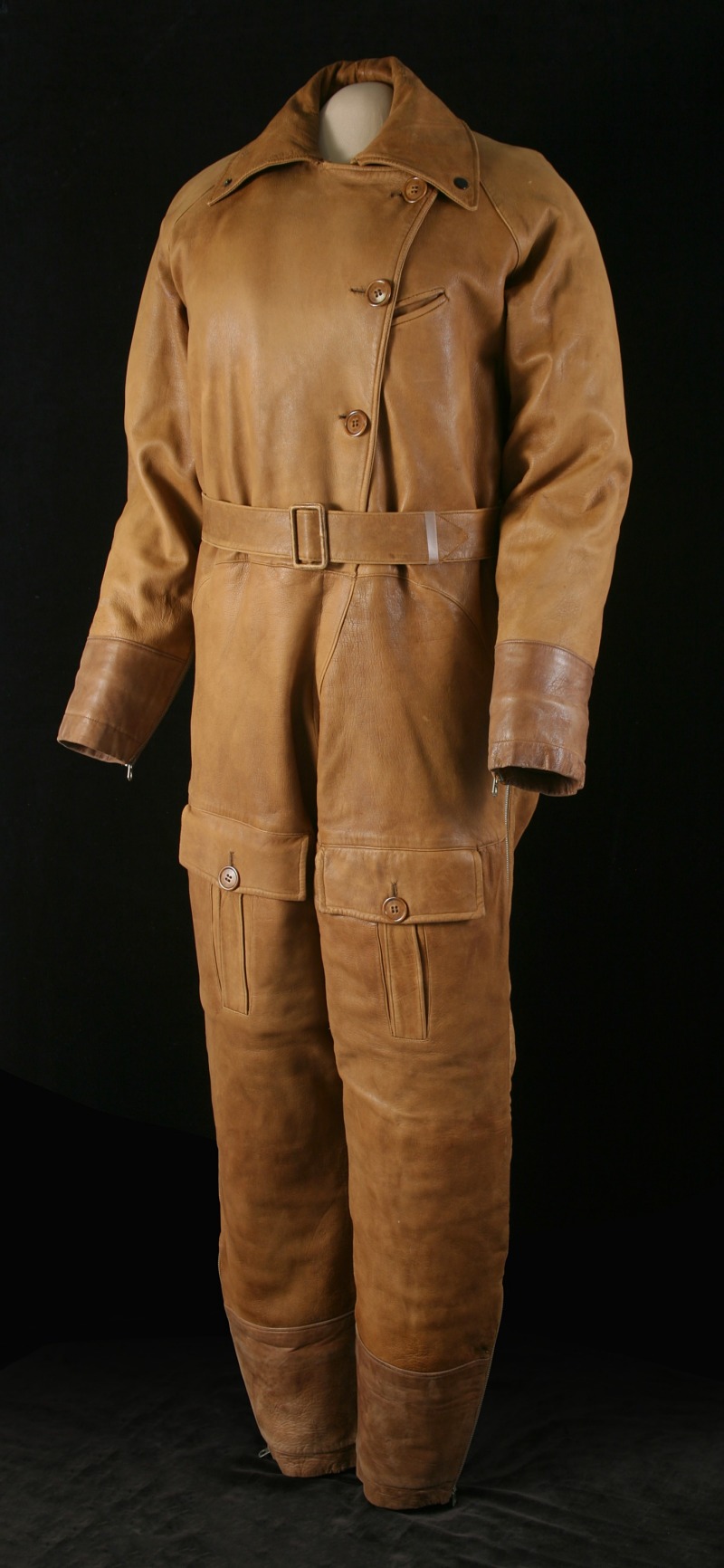
Flight Suit
Amelia Earhart wore this leather, wool-lined flight suit made by Arnold, Constable & Company, a fancy brand from Paris and New York. These suits were a must for long flights since early planes barely protected pilots from the freezing cold at 20,000 feet.
Amelia Earhart: Fashion For Women Who Soar!
Amelia Earhart wasn’t just a pioneering aviator—she was a style trendsetter too! Alongside Hollywood icons like Katharine Hepburn and Marlene Dietrich, she made slacks not just acceptable, but fashionable for women by the mid-20th century. In 1934, the Fashion Designers of America named her one of the ten best-dressed women in the U.S.
Amelia Earhart And Eleanor Roosevelt
We can see how influential and important Amelia was by this Photograph of her (on the left) and the First Lady Eleanor Roosevelt (on the right) from 1935. They are both dressed in outfits that were the height of fashion topped off with fur coats/stoles. It is said that these two powerful women were close friends. There is a famous story that in 1933, during a dinner party at the white house, they snuck off with a group of guests to go on a flight.
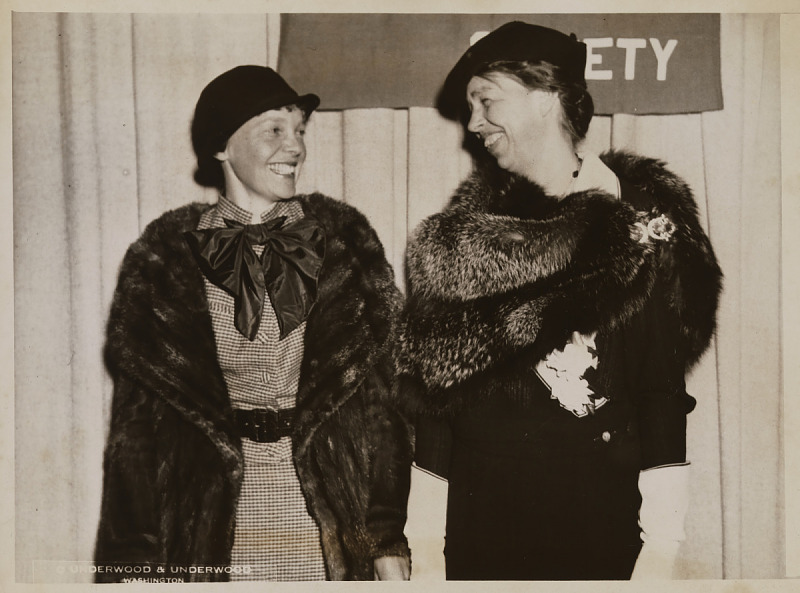
“It does mark an epoch, doesn’t it, when a girl in an evening dress and slippers can pilot a plane at night” According to Eleanor Roosevelt in the Baltimore Sun in 1933.
In the 1930s, women pilots like Amelia were stuck in men’s clothes that definitely wasn’t made for them. Amelia found women’s fashion way too stiff and impractical. So, in 1933, she thought, "Why not make my own?" and launched Amelia Fashions—for active women. With her sewing machine and a trusty seamstress, she whipped up designs and even modeled them herself.
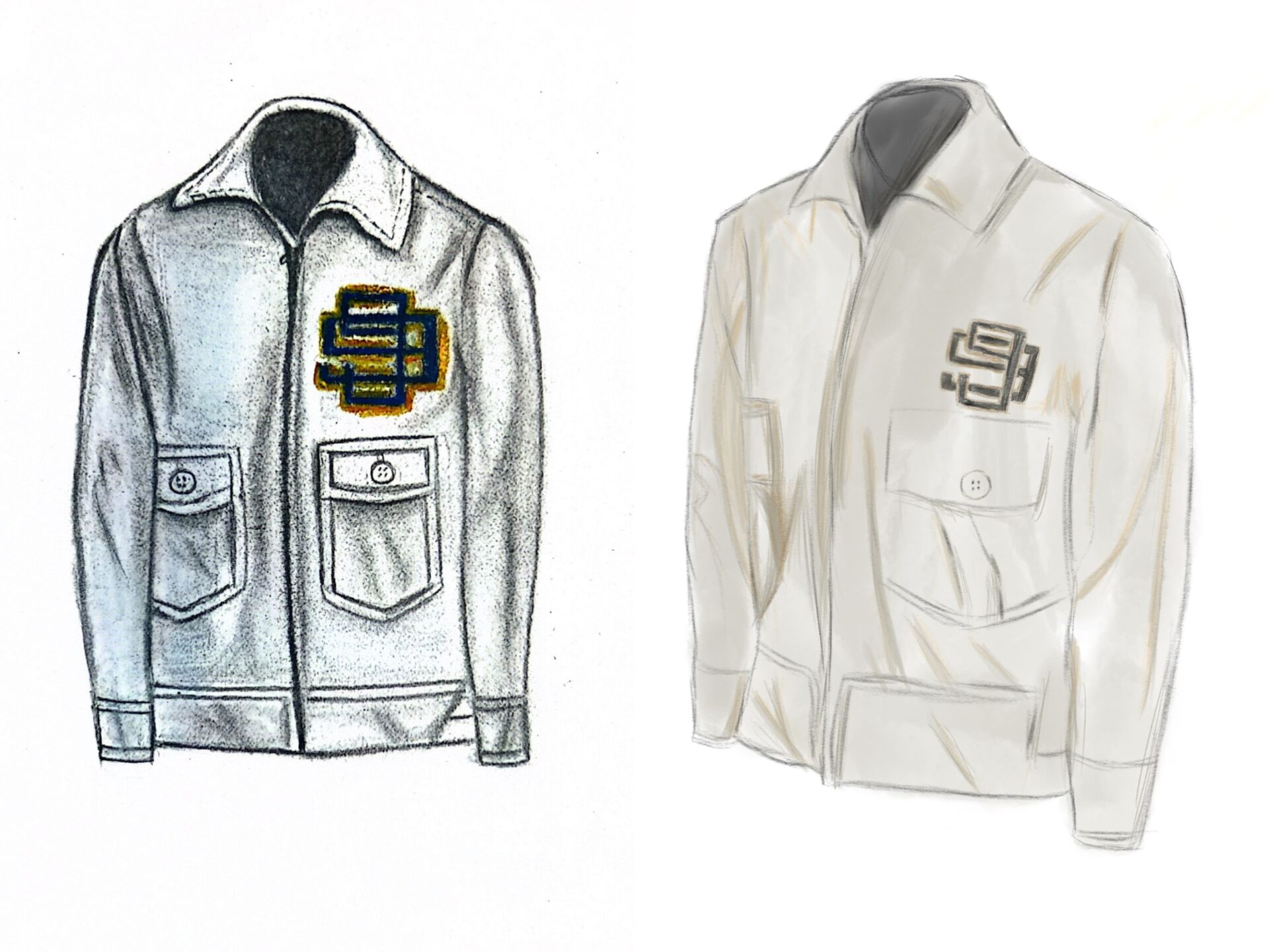
The left drawing is by Sakshi Manoj Sharma, 2024 and the right drawing is by Xiyu Tan, 2024.
Inspired by https://www.si.edu/object/jacket-suit-flying-civilian-ninety-nines:nasm_A19550103000
Flight Suit For Ninety-Nines
These sketches are of a top from a practical two-piece flying suit designed by Amelia for the Ninety Nines. The Ninety-Nines are a group of 99 female pilots created to support social, recruitment, and business goals for female pilots founded in 1929. Amelia Earhart, a staunch advocate for women in aviation, became the organization’s first president. Although her design for the flying suit did not make the cut, you might be able to spot the interlocking “9s” in her design that later became the iconic logo for the organization.
The Next Generation
There were many other groundbreaking female pilots:

Emily Howell Warner
Emily Howell Warner was an experienced aviator and a flight instructor for a long time before being hired as a commercial pilot. She watched many men who she had trained get hired before her. But through determination and passion she was hired in 1973 by Frontier. She was the first American woman to be a pilot for a commercial U.S airline and to do this would wear the same uniforms as the men.

Bonnie Tiburzi
Bonnie Tiburzi was hired in 1973 by American Airlines, making her the first American woman to be flying a major carrier plane. Like Emily, she had previously worked as a flight instructor.
There was a 40-year gap between Bonnie and Emily and their predecessor Amelia where women were still not allowed to be pilots. This clearly wasn’t to do with their flying skill so what was blocking them from those dreams?

Ellen Church: Pioneer Of The Flight Attendant Profession
Iowa-born Ellen Church aspired to be an airline pilot, a dream that was out of reach for women in her time. Undeterred, in 1930, she introduced a revolutionary concept to Steve Simpson at Boeing Air Transport: the inclusion of nurses on board airliners. With conviction, she demonstrated how the calming presence of female nurses could alleviate the public’s apprehension towards air travel.

The aviation uniform of the time was basically the same as the nurse’s which included a coat, a hat, and a skirt. Her coat was double-breasted, and her hat adorned with decorative ribbons.

Ellen not only envisioned this role but also crafted the job description and training program for the first flight attendants but also served as an attendant herself on flights between Oakland and Chicago.

Tragically, Ellen’s career as a flight attendant was short due to a car accident, her pioneering spirit and groundbreaking work laid the foundation for the profession and the evolution of in-flight service.
The Journey Continues…